Fast Answer: A one stop sourcing agency is a company that acts as a single point of contact between a buyer and a network of partner factories, managing sampling, production, quality inspection, and shipping across multiple facilities. Instead of a buyer negotiating with five factories separately, the agency absorbs that coordination and delivers one consolidated order. Twil Tex operates this model from Faisalabad, Pakistan, sourcing hotel, home, and medical textiles through vetted partner mills, with its own in-house Final Random Inspection before any shipment leaves the country.
What Is a One Stop Sourcing Agency
A one stop sourcing agency does not own the looms, the stitching lines, or the dyeing units that make your order. What it owns is the relationship, the vetting process, and the accountability. You send one spec sheet, agree on one price, sign one contract, and the agency figures out which mill in its network can actually produce it to spec, on time, and at the volume you need.
This matters most for a textile sourcing agency working in categories like hotel linen and home textiles, where a single order can span several product types. A hospitality buyer placing a container load might need terry towels, percale sheets, and embroidered pillow shams in the same shipment, each produced to that specific hotel's own GSM, thread count, and finish requirements rather than one generic spec across the board. Very few individual factories run all three product lines well. A sourcing agency solves that by routing each product to the mill that actually specializes in it, then consolidating everything into one shipment under one invoice.
The Sourcing Agency Model: Single Point of Contact, Multi Factory Access
How single point of contact sourcing actually works
In practice, single point of contact sourcing means every email, every revision, every payment term, and every shipping question goes through one team, not four or five factory sales reps in different time zones. When a hotel group orders bed linen and bathrobes for a 200 room property, that buyer talks to one merchandiser at the agency. That merchandiser is the one chasing the mills for updated production timelines, checking fabric specs against approved swatches, and flagging delays before they become late shipments.
This removes a specific kind of friction that direct factory buyers run into constantly: getting five separate WhatsApp threads to agree on a combined shipping date, or discovering that Factory A finished early but Factory B is two weeks behind, so nothing can be consolidated into one container.
Why a multi-factory sourcing model matters more than one big factory
Buyers sometimes assume that a bigger single factory beats an agency with several smaller ones. In hospitality and home textiles, that is rarely true, because no factory is equally strong at everything. A weaving unit that produces excellent cotton percale sheeting is often not the same unit set up for terry toweling, which needs different loom types and finishing lines altogether. This is the real difference in a multi-factory access vs single factory relationship: the agency's job is knowing which of its partner mills is actually the strongest for a specific product, then routing the order there, rather than forcing one factory to produce something outside its core strength just to keep the whole order under one roof.
Sourcing Agent vs Factory Direct: What Buying Directly From a Factory Really Looks Like
Where dealing directly with overseas factories works well
Going straight to a factory can work well in specific situations. If you are ordering a single product type in very large, repeat volumes, and you already have staff who speak the local business language, understand the compliance paperwork, and can travel for factory audits, direct sourcing removes the agency's margin from your cost structure. Some large hotel chains with dedicated procurement teams do exactly this for their highest volume, most standardized items.
Where it breaks down, and the risks of dealing directly with overseas factories
The trouble starts with anything that is not simple and repeat. A first time overseas buyer negotiating directly with a factory usually faces four recurring problems.
First, technical specifications get lost in translation. A buyer asking for "hotel grade" toweling without agreeing on exact GSM, twist level, and absorbency standards in writing can receive product that looks fine on a sample but performs poorly after repeated industrial washing.
Second, there is no independent party checking quality before shipment. If the factory that made the goods is also the factory that inspects them, there is an obvious conflict of interest.
Third, payment security becomes entirely the buyer's problem. Structuring a letter of credit, or negotiating a deposit against a bill of lading copy, requires financial and legal fluency that most first time importers do not have in house. We cover this in detail in our guide on payment terms with an overseas textile supplier.
Fourth, if something goes wrong mid production, the buyer has no leverage. A factory that already holds your deposit has limited incentive to prioritize a small or first time account over a repeat customer with larger volumes.
What's the Difference Between a Sourcing Agency and Buying Directly From a Factory: Side by Side
|
Factor |
One Stop Sourcing Agency |
Direct Factory Deal |
|
Point of contact |
One team manages all communication |
Separate contact per factory, per product |
|
Product range in one order |
Multiple product types consolidated into one shipment |
Usually limited to what one factory produces |
|
Quality control |
Independent inspection before shipment, for example Twil Tex's in-house FRI |
Factory often inspects its own output |
|
Pricing |
Includes a coordination margin, offset by fewer rework and delay costs |
Lower unit price on paper, but hidden costs from rework or delays |
|
Risk if a batch fails inspection |
Agency can reroute to another partner mill or hold shipment |
Buyer has no backup supplier, order timeline stalls |
|
Compliance and certification tracking |
Managed centrally across the vendor network |
Buyer verifies each factory's certificates independently |
|
Best suited for |
First time buyers, mixed product orders, hospitality and home textile programs |
Very large, single SKU, repeat orders with an experienced in-house procurement team |
|
Order flexibility |
Can blend smaller quantities across multiple product lines into one container |
Bound by that single factory's MOQ per product |
How Twil Tex Runs the One Stop Model for Hospitality Linen Buyers
Twil Tex is a Pakistan textile sourcing agency based in Faisalabad, the country's largest textile hub, and works as a sourcing and production management company rather than a manufacturer. We do not own the mills. What we manage is the network: partner factories across weaving, dyeing, terry production, and made up stitching that between them cover hotel bedding, bath linen, table linen, and medical and healthcare textiles.
A typical hospitality order runs through Twil Tex like this. The buyer sends a spec sheet with their exact GSM, thread count, and finish requirements for each item. We match each product line to the mill in our network best suited to produce it, agree a combined production timeline based on order size and fabric availability, and consolidate everything for one container load shipment. The buyer signs one contract and deals with one merchandising team from quotation to delivery, which is the core of why a hospitality linen sourcing partner exists in the first place.
How does a sourcing agency manage quality control across multiple factories
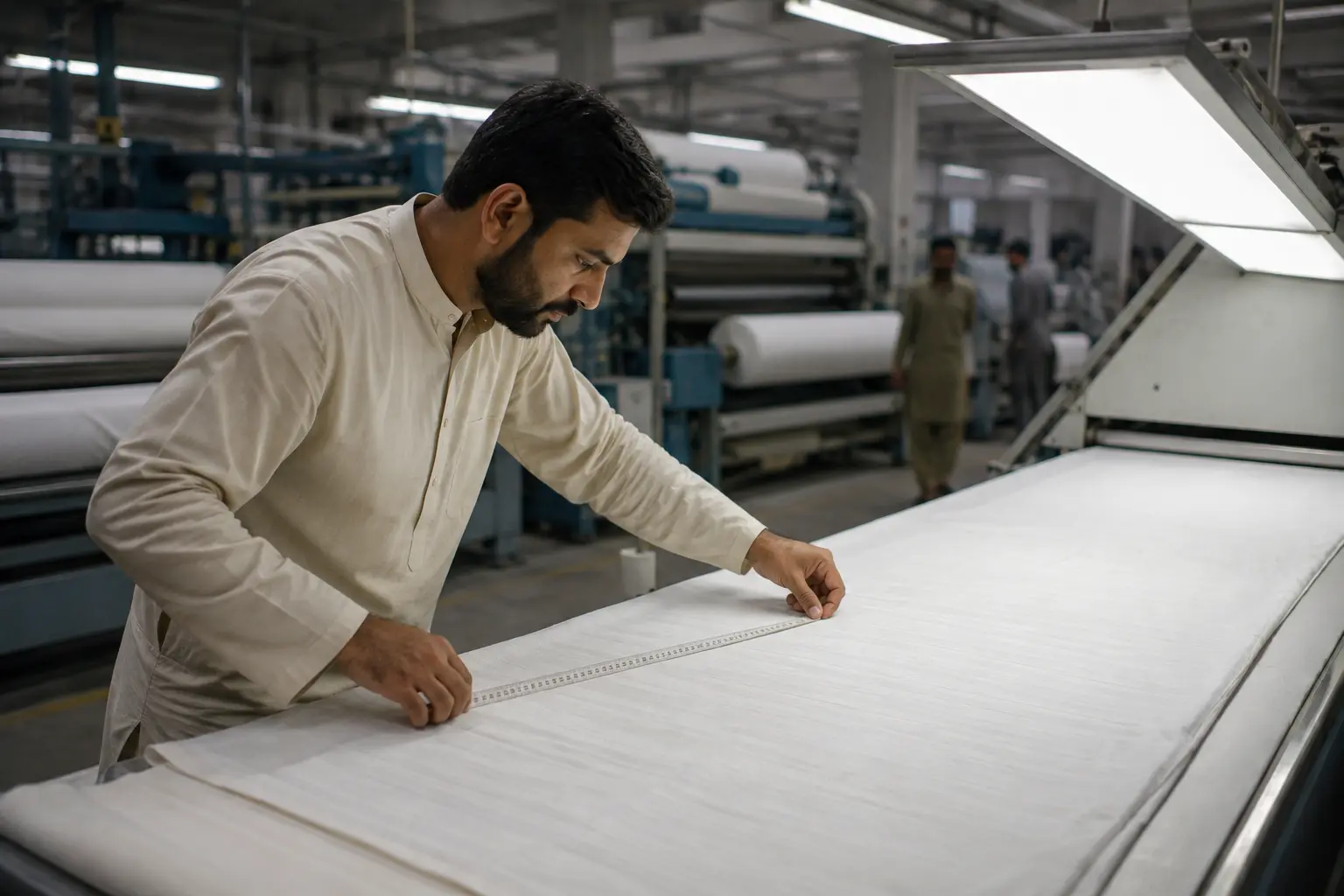
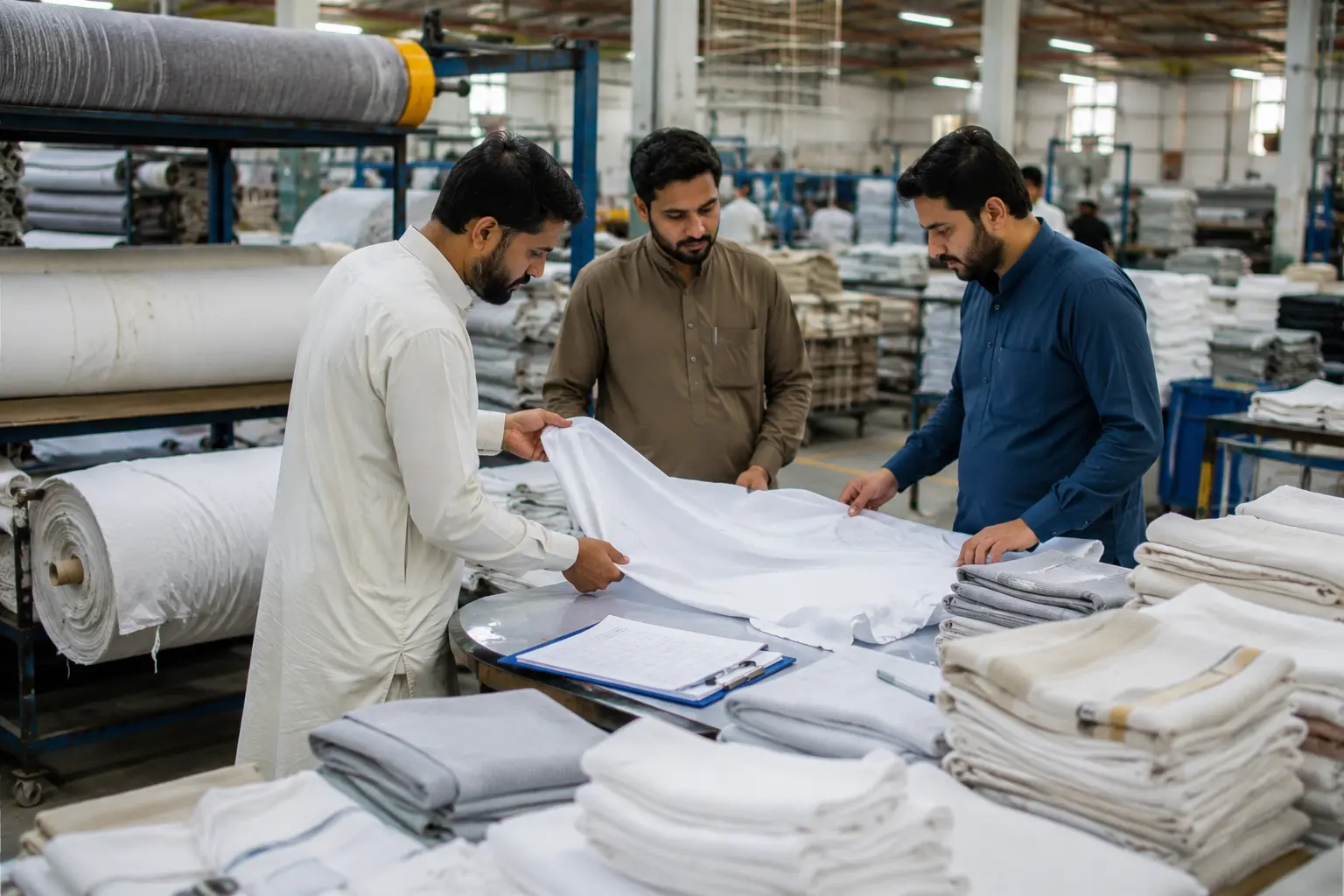
Before any order leaves Pakistan, it goes through Twil Tex's in-house Final Random Inspection (FRI). This is an independent check conducted by our own QC team, separate from the production mill, using AQL 2.5 sampling as the standard reference level for general hospitality and home textile goods. Inspectors check the finished goods against the approved swatch and agreed spec sheet, stitching consistency, colorfastness, and packing before sign off. This is the exact gap that direct factory deals usually leave open: nobody independent checking the goods before they ship.
Certifications backing the network
Our partner mills collectively hold certifications including OEKO-TEX, GOTS, BCI, Sedex, and ISO 9001, which matters directly for buyers in the UK, USA, and Europe where retailers and hotel groups increasingly require documented proof of safe, ethically produced textiles before onboarding a new supplier. You can review the exact scope of OEKO-TEX STANDARD 100 testing on the official OEKO-TEX certification page.
When Direct Factory Actually Makes Sense
To be fair to the direct route, it is not automatically the wrong choice. If you are an established hotel chain ordering very high volumes of one exact SKU on a recurring basis, already have staff who can audit factories in person, and your legal team is comfortable structuring international payment terms and Incoterms yourselves, cutting out the middle layer can lower your landed cost. The ICC's official Incoterms rules are the standard reference point for defining who bears cost and risk at each stage of that kind of direct shipment. See the ICC's Incoterms rules overview and the U.S. government's plain language explainer at trade.gov. For most buyers outside that narrow profile, the coordination, inspection, and risk absorption a full-service sourcing agency provides is worth more than the margin it charges.
Frequently Asked Questions
What is a one-stop sourcing agency?
A one-stop sourcing agency is a company that manages production across a network of partner factories on a buyer's behalf, acting as a single point of contact for sampling, manufacturing, quality inspection, and shipping, instead of the buyer coordinating each factory separately.
What's the difference between a sourcing agency and buying directly from a factory?
A sourcing agency coordinates production across multiple vetted mills and handles independent quality inspection before shipment. Buying direct means dealing with one factory's own team, own inspection process, and own timeline, with no backup supplier if something goes wrong.
Is it cheaper to source directly from a factory instead of using an agency?
The unit price on paper is often lower direct, but that number rarely includes the cost of rework, missed timelines, or shipments that fail quality checks after arrival because no independent inspection was done before loading. Once those risks are priced in, the total cost gap narrows significantly, especially for buyers without local factory audit access.
How does a sourcing agency manage quality control across multiple factories?
A properly run agency applies the same inspection standard and sampling method across every partner mill, regardless of which factory physically produced the goods. Twil Tex does this through its in-house FRI process, checked against AQL 2.5 sampling before shipment.
What risks does a sourcing agency reduce for hotel and hospitality linen buyers?
It reduces the risk of inconsistent quality across product lines, missed combined shipping deadlines, and having no independent check on the goods before they leave the country. It also reduces the compliance risk of dealing with a factory that cannot produce proper certification documentation.
How do payment terms differ between direct factory deals and sourcing agencies?
With a sourcing agency, payment terms and deposit structure are agreed once, centrally, and applied across the whole consolidated order. With direct factory deals, the buyer negotiates separate payment terms with each factory individually, which increases both the paperwork and the financial exposure if one factory underperforms.
Does Twil Tex work with a single factory or multiple factories?
Twil Tex works with a network of partner factories across weaving, dyeing, terry production, and made up stitching, and routes each product in an order to the mill best suited to produce it, rather than relying on one factory for everything.
Ready to Move From Multiple Factory Contacts to One
If your team is juggling separate quotes, separate timelines, and separate quality checks across different factories, that is exactly the friction a one stop sourcing model is built to remove. Twil Tex manages hotel linen, home textile, and medical textile sourcing from Faisalabad through a vetted partner mill network, backed by in-house Final Random Inspection before anything ships. Get in touch with our sourcing team to discuss your next order.